Inka Speech by Tony Sager JDPSN
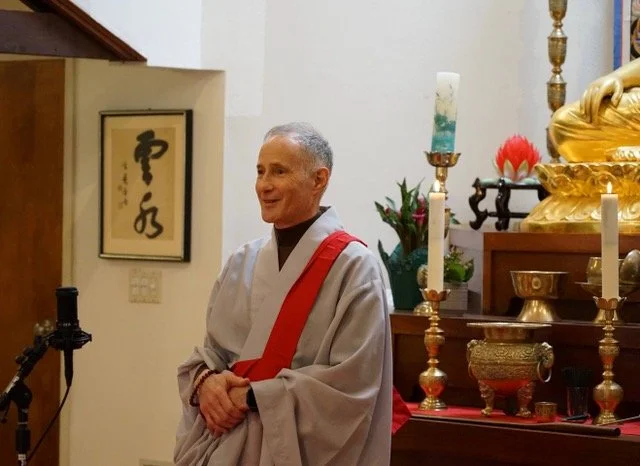
On December 13, 2025, Tony Sager received inka at Providence Zen Center, U.S.A.
[Raises the Zen stick over his head, then hits the table with the stick.]
Up is down, down is up
[Raises the Zen stick over his head, then hits the table with the stick.]
No up, no down
[Raises the Zen stick over his head, then hits the table with the stick.]
Up is up, down is down
Three different statements; which one is correct?
KATZ!
Up above lights are shining brightly, down below many Buddhas are are sitting on cushions and chairs!
Thank you all very much who are here in person and on Zoom for coming to the ceremonies this morning! It is my great joy and honor to be here with you.
When I look back upon my journey of having come to the Dharma it brings me back to when I was about seven years old because that is when a real life question appeared for me. What that was about was I noticed that it was my experience and was everyone else’s experience - my parents, my siblings, my little young friends, all the adults in my life - that life was this constant flux of up and down, mood swings and being constantly subject to external circumstances. What I noticed for myself is that when things went my way, when I got what I wanted, then that was an up and I was happy but when the opposite happened, then I plunged down and I wasn’t happy, a kind of suffering if you will. This was going on for everybody. At some point I began to question it because I thought this sucks and there’s got to be another way to meet one’s experience and navigate this life and if not, it’s going to be a long and crappy existence, honestly. So at some point I began to ask the the adults in my life about it and each time everyone said the same thing, “Tony, that’s just the way life is.” I would say “Okay, thank you,” but inside I thought, “No, there’s got to be another way and perhaps one day I will find it.”
As I got older that question stayed with me and surely it evolved in some respects. I knew I was looking for, was searching for something, but I had no idea where or what it was. Nothing religious in the conventional sense, nothing dogmatic ever resonated with me and so I knew I was not going to find it through those kinds of avenues, if you will. Then what happened was in 1978 I came here to Providence to attend college at Brown University and one October night that year I had a very deep experience. I was at the library trying to study but I could not focus; my mind was not caught on anything in particular but I could not concentrate and so at some point I gave up and went back to my dorm room. I sat down and then my mind entered a very deep space; I had never experienced anything like it before and it truly was a before-thinking experience during which there was a sequence of realizations that came to me. The first thing I saw was that I have a good life and would basically characterize myself as a happy person but that something is missing; I saw that I am happy but am not truly happy because I do not know who I truly am. My happiness was still often dependent upon external circumstances and I have a lot of ideas and notions of who I am and society tells me much about that but I don’t really know who I am. The next thing I saw is that there is a place before thinking and therein exists our true nature, our original nature before all the ideas and concepts of who I and everyone else are. I saw that we all have that in common, that we truly are not separate and that so much of the vast suffering in this world results from us human beings thinking we are separate. Next, I hardly knew anything about Buddhism and Zen outside of having read a book or two in a class the prior semester. I liked what I had read but I thought of it as just like high class philosophy or something; I did not understand anything about practicing it. But in that moment I knew oh, this is what the Buddha taught and the Buddha-Dharma is waking up to our true nature. I understood that practicing meditation is the work to realize our nature, to accomplish and get that. In that moment I knew that Buddhism was going to be my path and I was so happy because I had found what I had so long been hoping and looking for. The next thing I realized is that it will be very important to have the guidance and support of a teacher, a person who has accomplished this work her or himself otherwise it could probably be easy to go off of the path.
I then came out from that state and experienced a happiness that I never had experienced before because I knew I was on my way to the most important thing in my life.
Going to school in Providence I had heard of the Providence Zen Center, which back then was still in Providence on Hope and Wickenden Street, and their funny, charismatic Korean Zen Master. I thought, I have to go check that out, that maybe it’s the place for me to practice and learn about all of this. So I found out when Zen Master Seung Sahn (Dae Soen Sa Nim), was going to be in town again; it may have been a week or two later when he was going to give a public talk. I went there and as soon as he began to talk I knew I had found my teacher because everything that he said and did completely resonated with that experience I had had just some days prior.
Of course he talked about Don’t Know mind and before thinking, before name and form and that we all come from the same substance, the same cookie dough as he used to say. And he gave one of those wonderful teaching examples as he so often did; he help up his wrist watch and asked the assembly, “Is this a watch or is this not a watch? If you say ‘It’s a watch,’ you are attached to name and form, and if you say ‘It’s not a watch,’ you are attached to emptiness. So, what is it?” And then he demonstrated how to answer that clearly. That and everything he taught went right to the core of my being and I knew I had found my practice and spiritual home. So that is when I began practicing within our sangha.
There are so many great stories about the old Zen masters; one I would like share is about Ma Jo Zen Master from China. When he was a young student he practiced with his teach, Zen Master Huai-Jang. Ma Jo practiced in a little hermitage on the temple grounds and did so very intensively; he would sit meditation for hours upon hours, like a rock. His teacher saw that his young student had potential to become a great teacher himself one day and so one afternoon he thought, “I’ll go check on him and see how he’s doing.” He went to the hermitage and sure enough found Ma Jo sitting there like a rock, very tightly actually. Huia-Jang asked him, “Why do you practice meditation?” Ma Jo answered, “I PRACTICE TO BECOME BUDDHA.” His teacher said, “Okay, that’s cool, whatever.” There happened to be a brick laying there in the hermitage which Huia-Jang picked up and he sat down right beside Ma Jo and began rubbing, polishing the brick with a cloth. Of course this was disruptive for Ma Jo, who looked over and asked, “Teacher, what are you doing polishing that brick?” Huia-Jang replied, “Oh, I’m turning it into a mirror, I’m going to make a mirror out of this brick; that’s what I’m doing.” Ma Jo thought to himself, “Has my teacher gone nuts or what?” He said to Huia-Jang, “Master, that’s crazy, you can’t turn a brick into a mirror.” His teacher looked at Ma Jo said, “And you can’t become a Buddha by just sitting like that.”
That hit Ma Jo’s mind; he began to wake up a bit and see that he had been making a mistake because he wanted something from his practice. It was as if he was trying to get rid of some parts of himself and become something else, as if Buddhahood and awakening were outside of himself. Some time later he did become a great teacher. One of his known sayings is, “Originally, the self nature is complete.”
In the Diamond Sutra it says,
“All appearance is delusion.
If you view all appearance as non-appearance,
you will see your true nature.”
In the Avatamsaka Sutra it says,
“If you wish to thoroughly understand
All the Buddhas of past, present and future,
Then you should view the nature of the whole universe
As being created by mind alone.”
Ma Jo’s “Originally, the self nature is complete” and these sutra teachings point to our absolute, original nature which is before thinking, before name and form, before any idea or concept of who we, others and the whole world are. They point to our non-separate self which is always right here, right now and is awake to the present moment just as it is, unhindered by ever-changing external causes and conditions, ever changing external circumstances, those things we often think of as the ups and downs of every day life.
I have been through many difficulties and challenges in my life, including having been involved with another teacher which regrettably pulled me away from our sangha for quite some years. That turned out to be a very hard time in my life. But I never lost sight of that which I realized, what I saw that October night back in 1978 and afterwards has always been supported and made possible to deepen little by little, step by step through our sangha’s teaching and practice direction. And to my greatest joy I found my back home here to our sangha in 2015.
I have had the wonderful fortune to have known and practiced with Dae Soen Sa Nim, for whom I have great love and gratitude, and also to have practiced with and know many teachers of our sangha. I cannot say everyone’s name here now but I wish to express my deepest gratitude and love to my guiding teacher, Zen Master Wu Kwang, Richard; to Zen Master Soeng Hyang, Bobby; to Zen Master Hye Mun, Barry; to Zen Master Jok Um, Ken, and to Paul Majchrzyk Ji Do Poep Sa Nim. I thank you all so much for your love, care and support of me throughout the years. And I wish to express my love and gratitude to my beautiful partner, Randi, for all her incredible love and support.
There is so much suffering in this world, but our truth is always right here, right now, right in front of us; it never abandons us, and our clear direction of “How may I help you” can always manifests when we come back to, when we return to “What is this? Don’t Know.” Let us all practice continuously and help others in whatever ways we are able, moment to moment, situation to situation.
[Raises the Zen stick over his head, then hits the table with the stick.]
An eminent teach by the name of Zen Master Wu Kwang, our beloved Richard, once said, “The absolute realm is just this moment, completely cut off from any concepts of before and after, coming and going, good and bad, inside and outside, subject and object, and any other kinds of opposites that we create…the absolute nature of the universe is a pulsating expression of vivid energy flashing into existence.”
[Raises the Zen stick over his head, then hits the table with the stick.]
Zen Master Un Mun said, “Buddha is dry shit on a stick.”
[Raises the Zen stick over his head, then hits the table with the stick.]
Zen Master Dok Sahn said, “Buddha is three pounds of flax.”
Three statements, three teachings; which one is the truth?
KATZ!
Before me are many hungry Buddha bellies. After a few brief congratulatory talks let us all together enjoy a delicious lunch and cake! Thank you!