
Transmission Speech by Zen Master Dae An
[Raises the Zen stick over her head, then hits the table with the stick.]
Silence, action, words.
[Raises the Zen stick over her head, then hits the table with the stick.]
No silence. No words. No action.
[Raises the Zen stick over her head, then hits the table with the stick.]
Silence is silence. Words are words, and action is action. How can we make sense of that?
KATZ!
Very important: How we choose. What is needed from us in this moment?
I want to share today a little bit of my history about when I started to think about practicing Zen. Around 1980, I was in my second-year at academy. I had different subjects to study, including literature, grammar and an ancient language.
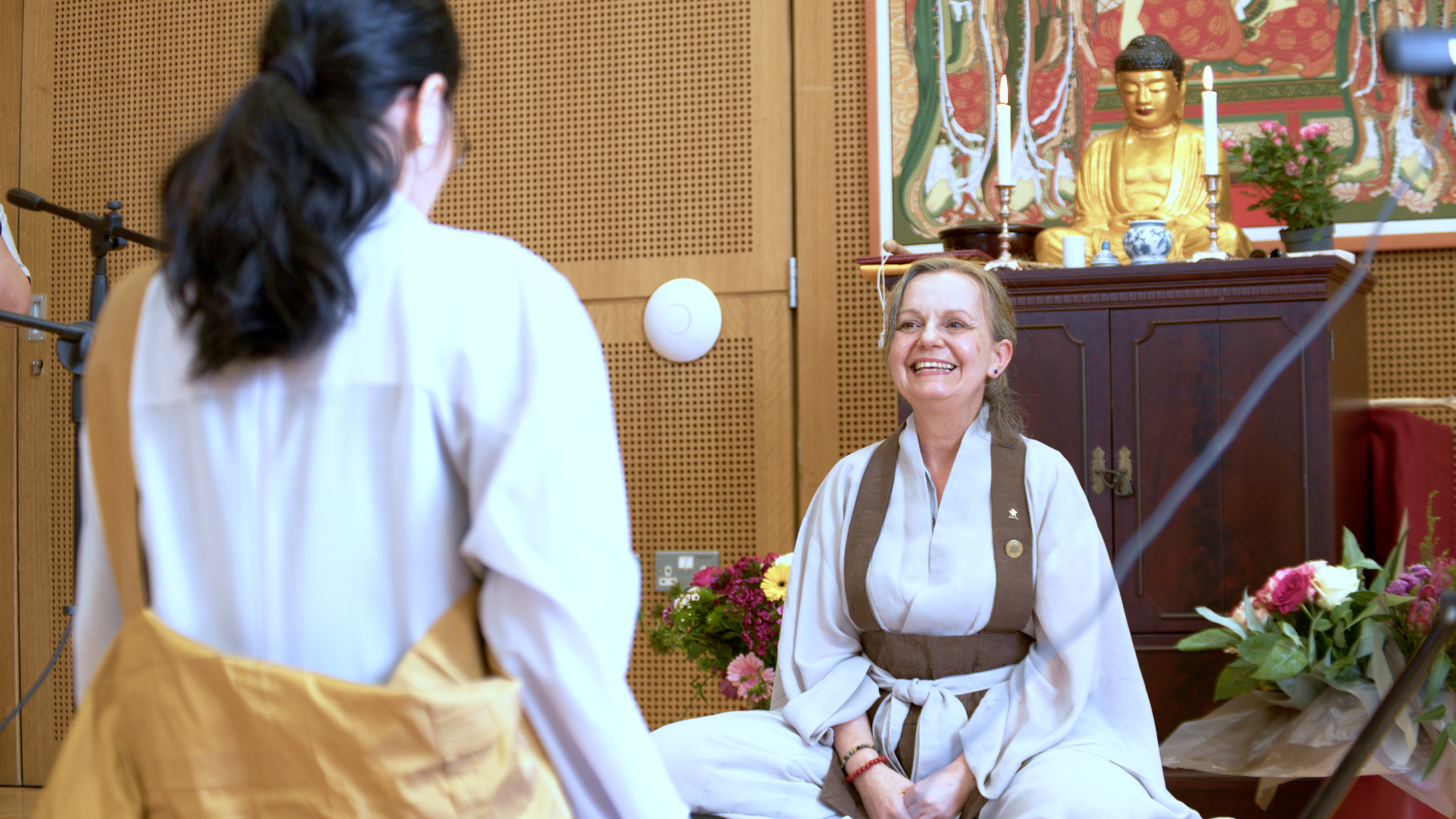
At that time, I had a teacher whose name was Kazimierz. He was a nineteenth-century literature teacher, and he was teaching us about the theoretical side of literature. That might not have been so exciting, but there was something interesting when he was in the room, and when he was teaching. I recognize him as my first Zen teacher.
I sensed something. I couldn’t even say to myself, “What was that?” After maybe six months, I asked him, “How do you teach? What techniques do you use?”
He was surprised. “What do you mean?” he asked. “I talk to you. I talk to all of you about the theoretical side of the literature, about poetry.”
I asked again, “Can you let me know? How do you teach?” It was difficult for me to ask clearly. I even didn’t know what my question meant.
He said, “Leave me alone.” He didn’t want to talk about it. It was all very interesting. It was also an interesting time in Poland. At that time, we were not entirely allowed to talk about religion. One day, I knocked at his office door and I asked him once more, “Can you tell me, how do you teach?” And then he told me, and he gave me an unusual book: The Three Pillars of Zen by Philip Kapleau. I found out later on, when he had talked a little bit with me, that my teacher was actually one of the first Zen students in Poland, practicing Japanese Zen with a Zen master, Philip Kapleau.
We had a little bit of discussion, but he didn't want to mix his job as a teacher with teaching me Zen. I was also very busy at that time, so I decided to focus on doing my master’s degree.
I asked one of my friends if she knew something about Zen in Poland, and she led me to a place that was not owned by our school but was just rented. I just felt this collective excitement. Everybody was so excited. It was 1981. I had this strong sense of “I want to come back, when I finish university.” Then I, decided, OK, maybe I should try to find it. But there was no internet back then to help. Yet I did find it. Now it’s called the Warsaw Zen Centre.
At the time I visited, Zen Master Seung Sahn was visiting Poland. He was busy, because many people came to see him. I wanted to ask him a question, but he was too busy for there to be time. I got back home a bit disappointed, because there was no space to do that. Maybe I was late, as he was about to depart for the United States.
In 1983, I finished university and then I was looking for a job as a teacher. I was able to find a job right away. It was actually in the same town where I had been a student, at the same high school. At that time in Poland, there was a long summer break. I thought to myself, for all of my short life—many years, primary school, secondary school, high school, then university—all those years, I was working and studying hard. And finally, I had these two months in which the job was already on the table. I thought, “I have to do something during this break,” and I went to Warsaw to sit a one-week retreat.
And that time in 1983, there were not actually teachers in Europe, but there was also already a small sangha, and they said, “Yeah, OK, you just come, and we will have a retreat. It would be like maybe ten of us, and then we’ll see how it will go.” I traveled about seven hours by train to get there. It was a difficult time for my body, difficult to maintain stability and silence, and being on the cushion was very physically—and emotionally—demanding.
After the retreat, I wasn’t sure what had just happened. But there was something, I didn’t know what it was. But it was clear that I could relax by just experiencing silence and this unique human connection. It was the first time in my life there was connection without words. And it really got me very deeply. It was what I needed. The pain wasn’t important.
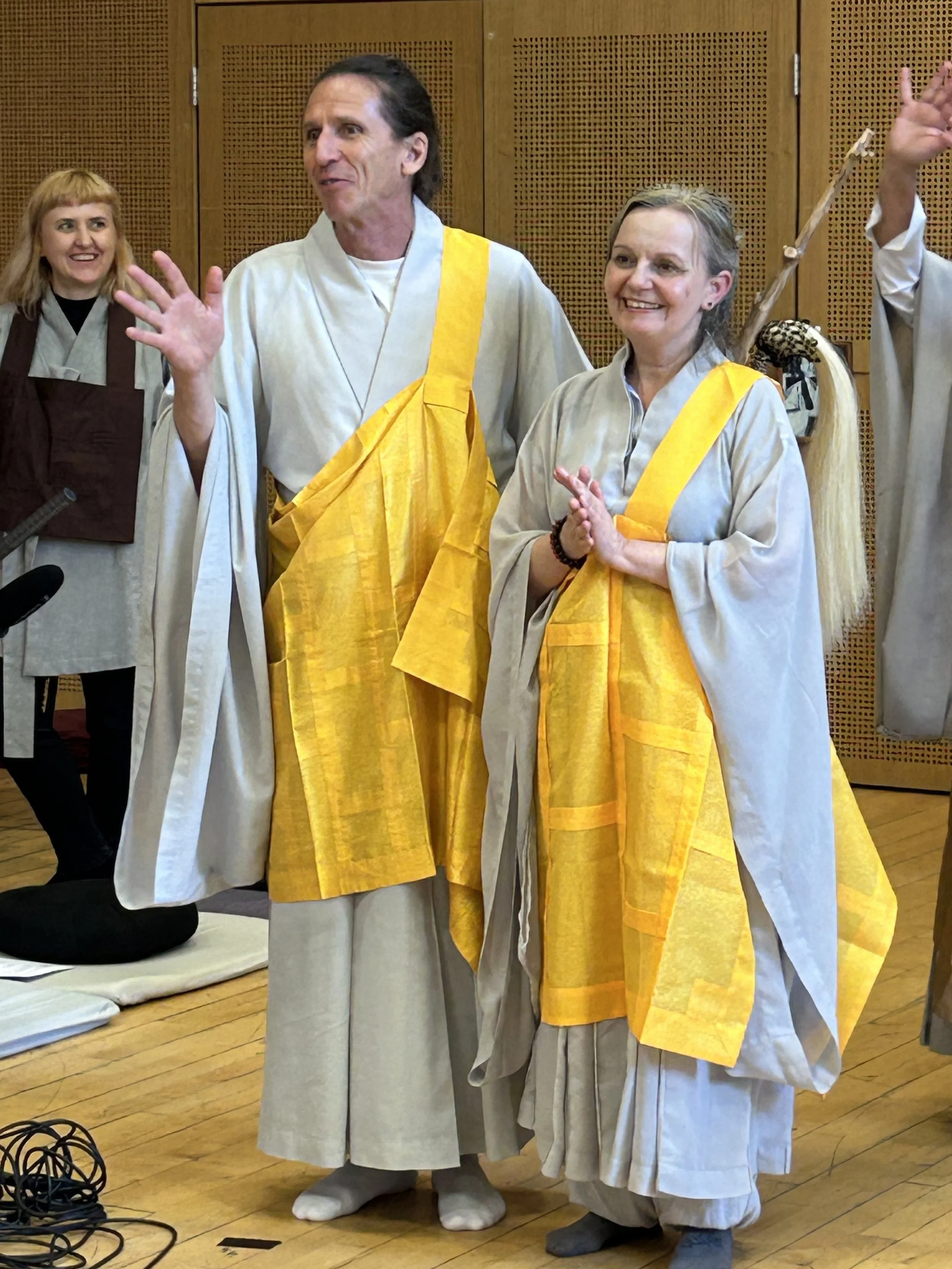
I remember that was an important moment when I experienced this situation. And when I can sit with people and experience silence, my practice is just to say “silence, silence.” When we have a retreat, we keep silence unless it’s necessary to exchange some information about the retreat.
Behind the words of my teacher Kazimierz, I finally understood the power of silence. That’s what we call “Before words, before speech.” There was not much actual explanation. I could clearly sense that something was behind his teaching. And sometimes I don’t know if he even noticed it himself.
This is amazing. It was so interesting, when he finally he told me that he was practicing meditation. From this little bit, there sprouted something about silence, about connection, and reading something behind the words.
I want to bring up a story from the seventeenth century. You might be familiar with haiku. Haiku is a type of poetry that is very short, usually three lines. In Japanese it’s five syllables, seven syllables, and five syllables. So, there was a famous young person who was well educated in seventeenth-century Japan. His name was Basho. If you look for haiku, Basho’s name always comes up. He was quite amazing, and his memory was impressive. He read a lot, studied a lot, and was interested in Buddhism. One day, he decided to go to a Zen master, and there was that first moment of meeting. We are all familiar with the feeling, when we meet with the teacher the first time. As I had been a student for a long time, I understood how he felt.
He asked some questions, and it was important for him to say, “You know, I read this; I read that; I study and I know. I know this from history; I know that from art.” He went on and on, and he couldn’t stop talking about how much he knew.
Finally, the Zen master said to him, “Now give me one sentence that is yours. Don’t look to your books. Don't look to your memory. Don't look to your past experience.”
Basho was surprised and stuck. And he just couldn't find anything. The teacher kept saying, “Give me! Give me!” He prompted him over and over.
Then, at one moment, he came up with something: “Still pond, still pond. Frog jumps, the splash.” Actually, this is what he saw and heard. Outside the window there was a garden, and there was a small pond, and a frog had jumped in.
And the Zen master said, “That's wonderful!”
This little moment, when he was completely in the moment—it’s very interesting. Where did he find this? Where did he find this point? His teacher asked a question, and that helped Basho to reach his before-thinking mind, his before-analyzing mind. Sometimes we say these experiences are coming from don’t-know mind. Maybe he wasn’t 100 percent conscious where he got this answer from, but he was sure, and this beautiful haiku came out.
Perhaps he didn't even think they were his own words, only that words appeared. And sometimes we call these “alive words.” There was actually in the past a Zen school called Alive Words.
One more story. This one is about a person living in the eleventh century, who was also quite young. He was unusually bright, so he was quickly employed by the government. Because of that, he was always traveling. He was well-educated and very clever. He also wanted to explore Buddhism. So he went to different Buddhist temples. At that time, Buddhism was quite well developed in China.
He was always asking questions because he could memorize many things. He could memorize what was on page 145 and compare it with what was on page 233. So, he would go around and ask questions: “Tell me, what is the teaching on page 245?” Nobody could do it; they just couldn't give him answers. So he was proud, and he memorized everything he wanted.
There he was, going out with all this knowledge about Buddhism. Finally at one point, people started to him Mr Scales. He could weigh the mind or the memory of anyone, all the people around. But one day, someone he was talking to told him, “You may try this Zen master. You might have a problem with him. You might try to challenge him.” So he decided to go there and do it. He actually came into the dharma room without waiting. It was traditional to wait until someone opened the door, but he just came in and sat down with his back to the Buddha.
This was quite arrogant behavior in this tradition. The master came and said to him, “Oh, such a great and famous person has come. Please, welcome.”
And then Mr Scales said, “Yeah, I came to see you. I’m just traveling around. I have my important jobs. And then I just came to see you. It’s a good opportunity for you to meet me to exchange something with you.”
And all of a sudden, this Zen master shouted, “KATZ!” and asked, “Tell me, Mr. Scales, how heavy is this?”
And then Mr Scales looked in his mind to all the many pages and pages he had studied. He just couldn't find it. So that was the beginning of when he started to open his mind. He got stuck, and even his great memory couldn’t help. His clever mind couldn’t help him. That's the beginning of his path of practicing.
Before that, he did lots of reading. But then from this moment he started to actually practice until he stopped checking. That was the beginning of his don’t-know mind.
So I guess I have more stories, but now I will try to embrace all this, our stories, and my life story—the story of how we get to a don’t-know mind.
They present some teaching. My question is: What is that? What actually are all these stories about?
KATZ!
This little or big question, which may appear randomly, or someone may put on us and push us to look into it, is very important. And this keeping before-thinking mind is very important too. So today, I presented my first dharma talk. Thank you for listening. And thank you for being here.